
Do you really need £2 million to retire comfortably?
As inflation pushes prices higher, retirement is becoming ever more costly in the UK.
In 2026, Pensions UK’s Retirement Living Standards suggest that a comfortable 30-year retirement could cost a couple around £2 million. However, in reality, even £2 million might not be enough to comfortably sustain you and your partner for the rest of your lives.
Growing your pension and other savings to keep pace with rising costs is rarely straightforward, especially if your income isn’t increasing regularly to account for inflation. But with comprehensive retirement planning, you can help keep your savings on track to achieve your retirement goals.
Read on to explore the key considerations for calculating your retirement costs, as well as how to evaluate your savings against your goals.
The Retirement Living Standards provide estimates for three lifestyle tiers
Pensions UK’s Retirement Living Standards offer broad cost estimates based on the latest price data. They include costs for both single people and couples across three lifestyle tiers, as shown below.
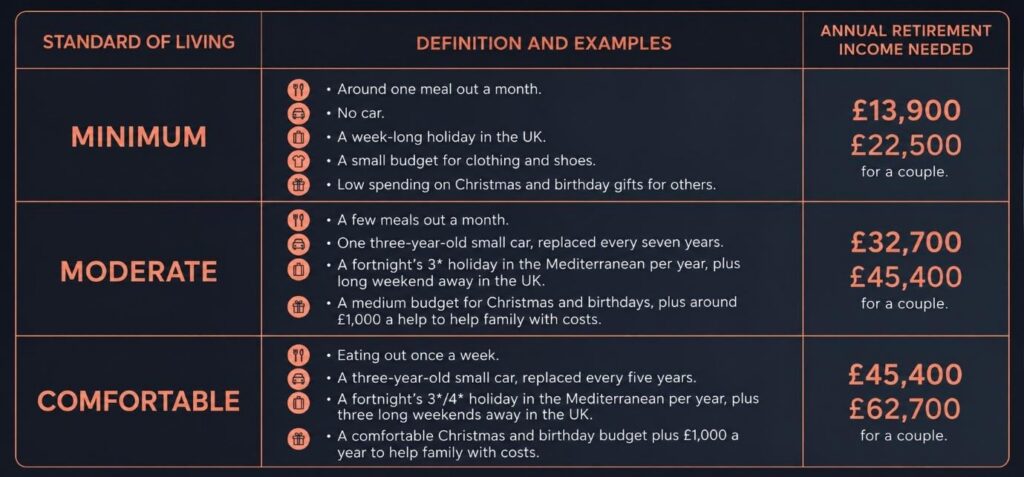
Source: Pensions UK
So, on average, a retired couple living comfortably will spend around £62,700 in 2026. Over 30 years, spending at this level would require savings or other income totalling almost £2 million.
However, actual costs are likely to be even higher.
Key variables aren’t factored into the Retirement Living Standards
Whether you’re saving towards a comfortable, moderate, or minimum lifestyle in retirement, your costs could end up being much higher than the Retirement Living Standards’ estimates.
This is because the following factors are not included in the calculations:
- Inflation: Prices are likely to continue rising both up to and during your retirement. If inflation followed the same trends as over the past 30 years (average 2.42%), the Bank of England’s inflation calculator suggests £62,700 could grow to £129,478 a year by the end of your retirement. However, actual inflation will fluctuate and could be significantly higher or lower over the next few decades.
- Regional premiums: The estimates are based on national averages, with costs likely to be higher in some parts of the UK. For example, Pensions UK suggests a comfortable retirement for a couple living in London costs £64,800 a year in 2026.
- Healthcare costs: Depending on your health, you may incur significant care costs, particularly later in life. According to Carehome.co.uk, residential care costs £1,298 a week on average as of June 2026. These expenses are not included in Pensions UK’s estimates.
- Other large expenses: While the Retirement Living Standards may provide a comprehensive overview of annual costs, they don’t include less regular large expenses. For example, if you’re planning a bucket-list holiday or significant home renovations, you’re likely to spend more.
- Gifting: You may be hoping to gift large sums to your loved ones during your retirement, such as to help a child or grandchild get married, buy a home, or start a business. The Retirement Living Standards only cover a moderate amount of gifting, so you also need to consider any larger gifts.
What’s more, your spending habits are unlikely to be consistent throughout retirement. Often, retirees will spend more on holidays, socialising, and hobbies in the early years. Later, as their health and mobility start to decline, many people will spend less. Then, in later life, spending often rises again as people incur significant healthcare costs.
So, retirement planning isn’t as simple as multiplying a headline figure by the number of years you expect to be retired.
Calculate how much you have saved for retirement so far
As you plan for retirement, it’s important to carefully consider how much you’re likely to spend – and, therefore, how much you need to save.
As a first step, it’s wise to conduct a full review of your retirement savings and any other income you can expect after you stop working. For example, you might wish to include:
- Private pensions
- State Pension payments
- Investment income
- Non-pension savings
- Rental and other property income.
In some cases, you might be expecting to receive an inheritance before or during your retirement. While you may wish to keep this in mind, expected inheritance shouldn’t be the foundation of your retirement plan, as circumstances can change quickly and dramatically.
Accurately forecast your costs throughout retirement
Once you have a clear, comprehensive view of your potential retirement income, you can start evaluating how far those funds could stretch.
The Retirement Living Standards are a good starting point for calculating your costs. Using the estimates as a baseline, you can add, remove, and amend costs depending on your needs, goals, and preferred lifestyle.
As described above, you then need to consider:
- How inflation could increase those costs over time
- How your spending habits will evolve throughout retirement, including potential care costs
- Any other financial goals, such as a bucket-list holiday and gifting.
These calculations can be complex. However, by carefully considering your needs and priorities, and working with a financial planner to forecast your costs, you can plan a sustainable retirement income that supports your goals.
Create a plan to boost your savings
Whether retirement is just around the corner or further down the line, it’s never too late or too soon to start planning.
With an understanding of your current savings and estimated costs, you can identify any shortfall between what you have now and what you’ll need in retirement. Then, you can create a plan to make up the difference.
For example, you might choose to:
- Increase your pension contributions
- Manage your schemes to reduce fees and boost returns
- Build additional income streams
- Adjust your retirement plans – such as retiring later or revising your goals.
At Chancellor, our financial planners can create a plan that works for you. Taking your current financial circumstances and retirement goals into account, we can work with you to:
- Grow your retirement savings
- Calculate your likely costs in retirement
- Define a sustainable income that supports your ideal lifestyle throughout retirement.
Get in touch
Whether you’re new to Chancellor or already working with our financial planners, we can support you to create a comprehensive retirement plan that’s tailored to you.
Email info@chancellorfinancial.co.uk or call 01204 526 846 to speak to an adviser.
If you’re already a client here at Chancellor, contact your personal financial adviser to discuss any of the content you’ve read in this article.
Please note
This article is for general information only and does not constitute advice. The information is aimed at individuals only.
All information is correct at the time of writing and is subject to change in the future.
A pension is a long-term investment not normally accessible until 55 (57 from April 2028). The fund value may fluctuate and can go down, which would have an impact on the level of pension benefits available. Past performance is not a reliable indicator of future performance.
The tax implications of pension withdrawals will be based on your individual circumstances. Thresholds, percentage rates, and tax legislation may change in subsequent Finance Acts.